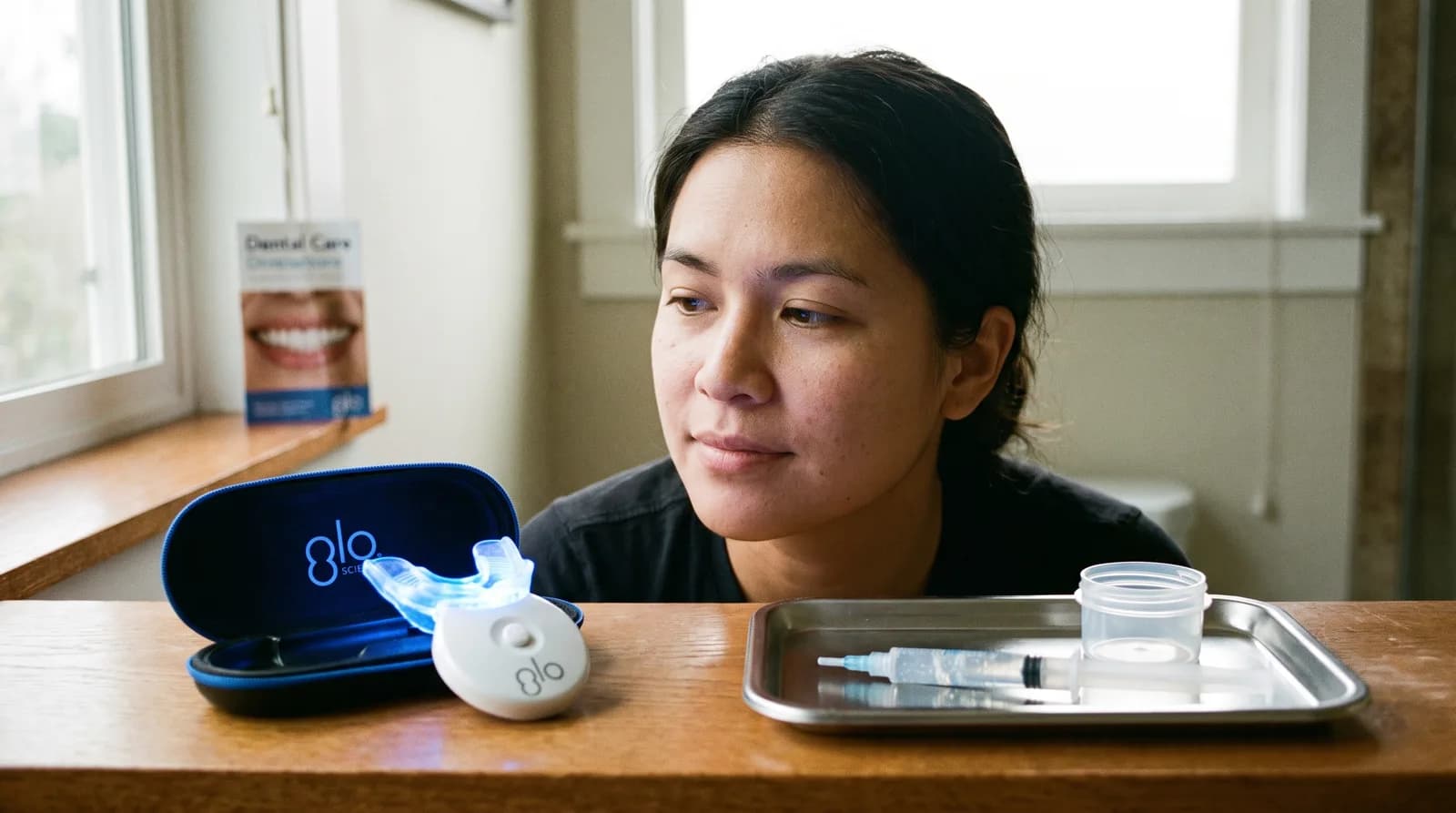
Cosmetic Dentistry
GLO Teeth Whitening vs Traditional Whitening: Compared
GLO teeth whitening vs traditional whitening: how they compare on speed, sensitivity, results, convenience, and overall cost for your smile.
Aug 24, 202610 min read



Invisalign for young professionals solves a specific worry that traditional braces never quite address: showing up to a client meeting, a first date, or a job interview with a mouth full of visible metal. Clear aligners let you fix your bite and straighten your smile without announcing it to every room you walk into, at a stage in your career when first impressions genuinely carry weight.
This isn't a purely cosmetic concern either. Crowded or misaligned teeth can make brushing and flossing harder, which raises the odds of cavities and gum irritation over time. Fixing that alongside the appearance benefit is part of why so many people finally pursue treatment during these years rather than putting it off indefinitely.
If you've been putting off Invisalign treatment because you can't picture fitting it around your calendar, this covers exactly how it works around a demanding job rather than against it.
Young professionals choose Invisalign over braces mainly for discretion and convenience, since clear aligners are nearly invisible in daily interactions and don't require the same lifestyle adjustments metal brackets do. Invisalign for young professionals specifically appeals to people balancing client-facing work with a personal appearance they'd rather not put on public display for a year or more.
| Factor | Invisalign | Traditional Braces |
|---|---|---|
| Visibility | Clear, hard to notice at conversational distance | Visible metal brackets and wires |
| Office visit frequency | Every 6 to 8 weeks | Every 4 to 6 weeks, plus unplanned repairs |
| Eating and drinking | Remove aligners first, no food restrictions | Sticky, hard, or crunchy foods restricted |
| Emergency visits | Rare | Broken brackets or poking wires happen |
Early career years are full of moments where a confident, unremarkable smile matters: interviews, client-facing meetings, presentations, networking events. Traditional braces put a visible signal on your face for one to three years, right during a stretch when a lot of people are actively trying to be taken seriously in new professional settings. Invisalign removes that particular tradeoff entirely.
Invisalign is genuinely discreet at work; the aligners are made of clear plastic that's difficult to notice at a normal conversational distance, especially compared to metal brackets and wires. Most coworkers and clients won't clock that you're wearing them unless you point it out.
This matters more than it might seem for anyone in a client-facing or presentation-heavy role. A confident smile reads as confidence generally, and most people don't want a visible dental appliance becoming part of every first impression they make for the next year or so. Invisalign sidesteps that specific concern almost entirely.

One honest caveat worth knowing upfront: some cases use small tooth-colored attachments to help the aligners grip certain teeth, and those are slightly more visible up close than the aligners alone. Our guide to Invisalign attachments covers exactly what these look like and how noticeable they actually are, since it's a fair question and the honest answer is "somewhat, but far less than brackets and wires." Whether your case needs them at all depends on what specifically needs to move, which your consultation will clarify.
Yes, Invisalign fits around a busy work schedule well, since most check-in appointments are quick and spaced out, and the aligners themselves require no daily adjustment or emergency visits the way broken brackets sometimes do. It's built for people who don't have flexible daytime hours.
Here's what a typical schedule commitment looks like:
Compare that to traditional braces, which sometimes require an unplanned visit when something breaks mid-workday, right in the middle of a project deadline or a travel-heavy week. Invisalign's structure removes most of that unpredictability from your calendar entirely.
Curious how it would fit your specific schedule?
A free consultation gives you a real timeline and appointment cadence to plan around.
Request an Appointment →You can eat and drink normally during work meetings as long as you remove your aligners first, since anything besides water should be consumed without them in. Most professionals build this into their routine without much friction once it becomes habit.
The practical adjustment is timing, not restriction. Coffee during a morning meeting, lunch with a client, drinks after work, all of it is on the table exactly as before, just with a brief pause to remove the aligners first. A lot of professionals keep a small case in their bag or desk specifically for this, which makes the whole routine close to automatic within a few weeks.
The one habit that actually matters here is brushing before putting the aligners back in, since trapping food particles or sugar against your teeth under a snug-fitting aligner for hours isn't great for your enamel. Carrying a travel toothbrush, or at minimum rinsing with water, covers most of that risk without requiring a full bathroom routine at your desk between every meeting.
Office visits during Invisalign treatment typically happen every 6 to 8 weeks, and each one is quick, usually under 20 minutes, to check progress and hand off your next set of aligners. That's a much lighter schedule commitment than most people expect going in.
Compare this to the mental model most people carry over from childhood memories of monthly orthodontist visits with parents in the waiting room. Adult Invisalign treatment doesn't run on that cadence. The wider spacing between visits reflects how much of the actual work happens passively, at home, rather than requiring hands-on adjustment at every appointment.
MouthHealthy, the ADA's patient education site, notes that orthodontic treatment success depends heavily on following the prescribed wear schedule, which for aligners means roughly 20 to 22 hours a day. The infrequent office visits work specifically because so much of the actual treatment happens passively, just by wearing the aligners through your regular day rather than needing a professional to manually adjust anything.
Invisalign causes a mild, temporary speech adjustment for some people during the first few days of wearing a new aligner, usually a slight lisp that resolves as your tongue adapts. It's rarely noticeable to anyone but you, and it fades quickly.
Most professionals report this settling within a week of starting treatment, and many don't notice it at all beyond the very first day or two with each new set. The plastic is thin enough that the adjustment period tends to be brief, and it's often less noticeable than people brace themselves for going in. One study evaluating orthodontic movement accuracy with aligners found overall tooth rotation accuracy of 86%, with some movements reaching 96% to 98% precision, supporting how predictable modern aligner treatment has become.
If you have an unusually high-stakes presentation or call coming up, timing a new aligner change a day or two earlier gives your mouth a little runway to adjust beforehand. This is a minor logistics detail, but it's an easy one to plan around once you know your own calendar and treatment schedule.
Treatment length for common cases like mild to moderate crowding or spacing typically runs 6 to 18 months, depending on how much movement your teeth need. More complex bite corrections can take longer, closer to the higher end of that range.
These longer cases are less common among the mild alignment concerns that bring most young professionals in for a consultation in the first place.
Most young professionals fall into the mild to moderate category, since the concerns that bring people in at this life stage, minor crowding, small gaps, a bite that's felt slightly off for years, tend to fall on the shorter end of the treatment spectrum rather than requiring extensive correction. That's not universal, but it's the common pattern.

A study comparing patient satisfaction found 92% of clear aligner patients reported being satisfied or very satisfied with their treatment, compared to 76% of traditional braces patients, a gap researchers linked partly to comfort, aesthetics, and ease of maintaining oral hygiene throughout treatment. For most young professionals with mild to moderate alignment issues, that timeline fits comfortably within a normal career stretch without feeling like an open-ended commitment.
Getting started just requires booking a consultation, where your case gets assessed and you get a realistic timeline and appointment schedule to plan around before committing to anything. There's no need to clear your calendar or restructure your workweek to make this happen.
The process typically looks like this:
Our guide to Invisalign for adults covers candidacy questions that come up regardless of career stage, if you're still weighing whether treatment makes sense for you at all. Either way, the appointment itself takes less time than most people assume, and it's the only real step required to find out what your specific timeline would look like.
A lot of people spend more time deliberating over whether to book the consultation than the consultation itself actually takes. If discretion and scheduling flexibility are the two things holding you back from starting, both of those concerns get addressed directly in that first visit, with a real answer instead of general reassurance about how it'll probably work out fine.
Ready to straighten your smile without slowing down?
Book a consultation that works around your schedule, not the other way around.
Book Appointment →Invisalign for young professionals works because it asks so little of your calendar and even less of your appearance day to day. Infrequent appointments, a discreet look, and a predictable timeline make it a realistic fit for people whose schedules genuinely don't have room for anything less flexible. The career-stage worry about visible braces derailing how you come across at work is exactly what this treatment is built to sidestep. Results may vary. Please consult with your dentist at Susan J. Curley DDS for personalized treatment recommendations.
Ready to see what your timeline would look like?
Book a free consultation and get a real schedule to plan around before committing to anything.
Book Appointment →Curious what a free consultation actually involves?
See what to expect →Written By
Dentist
GLO teeth whitening vs traditional whitening: how they compare on speed, sensitivity, results, convenience, and overall cost for your smile.
Porcelain veneers process step by step: consultation, tooth preparation, temporaries, fabrication, and placement, visit by visit.
Chipped tooth repair options same day: dental bonding vs a same-day crown, what to do right now, and what your emergency visit will look like.
Book your visit with Dr. Curley online or call us, and we'll take it from there.