crowns
Temporary Crown Care Tips: What to Avoid Before Your Crown
Temporary crown care tips: what to avoid eating, how to floss carefully, and what to do if it comes loose or falls off entirely.
Sep 13, 20269 min read



The most common question adults ask before starting Invisalign is not about cost or timeline. It is a simpler, more personal one: is it too late for me? The short answer is no. Invisalign for adults is not a younger person's treatment repurposed for an older market. It is genuinely well-suited to adult life in ways that traditional braces are not, and the reasons adults most often hesitate, including visibility, lifestyle disruption, and whether it works on adult teeth, are exactly what Invisalign was designed to address.
At Susan J. Curley DDS in Wall Township, NJ, Dr. Curley provides Invisalign treatment for adult patients who want straighter teeth without the brackets, wires, and social self-consciousness that come with conventional orthodontics.
There is no upper age limit for Invisalign. Adults in their 40s, 50s, 60s, and older complete successful treatment regularly. The relevant factors are healthy teeth and gums and the type of alignment issues, not the patient's age.
There is no upper age limit for Invisalign. Adults in their 40s, 50s, 60s, and older complete successful Invisalign treatment every day, and age alone is not a disqualifying factor. The relevant question is not how old you are but whether your teeth and gums are healthy enough to support tooth movement, and whether the specific alignment issues you have are within the range that Invisalign can address.
Adult teeth move through the same biological process as teeth at any other age: gradual pressure applied by the aligners stimulates the bone around the tooth root to remodel, allowing the tooth to shift. The process is somewhat slower in adults than in adolescents because adult bone is denser, but the difference in treatment time is typically modest for most cases, and the biological mechanism is identical.
What matters most for candidacy is not age but the health of the foundation. Active gum disease, significant bone loss, or untreated cavities should be addressed before orthodontic treatment begins, because moving teeth through compromised tissue or bone does not produce lasting results. Dr. Curley evaluates all of these factors at the initial Invisalign consultation.
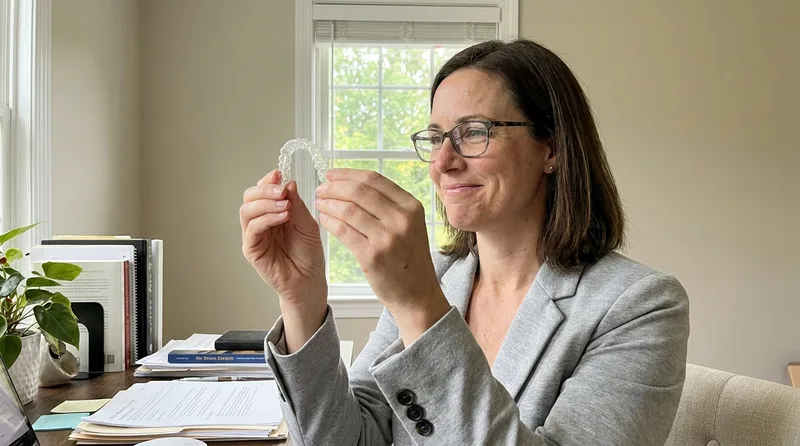
Invisalign for adults addresses crowding, gaps, overbite, underbite, crossbite, and open bite for mild to moderate cases. It is also used to align teeth before restorative work such as veneers or implants, making it a useful pre-treatment step for many cosmetic plans.
Invisalign for adults addresses most of the same alignment concerns that conventional braces treat, including crowded teeth, gaps, overbite, underbite, crossbite, and open bite. It is particularly effective for the mild to moderate cases that make up the majority of adult orthodontic concerns, and advances in aligner technology have extended its capability to handle increasingly complex presentations that once required braces.
Common adult concerns Invisalign addresses well:
Cases that are less suited to Invisalign include significant skeletal discrepancies that require jaw surgery to correct, or certain severe rotations and vertical movements that still respond better to fixed appliances. An honest consultation establishes clearly which category your case falls into.
Invisalign fits adult life in ways that conventional braces do not: it is virtually invisible, removable for meals and important occasions, and requires far fewer emergency office visits. Most adults report that the adjustment period is shorter than they expected.
Invisalign aligns closely with how adults actually live their lives, in ways that conventional braces often work against. Most adults considering orthodontics are not teenagers who can absorb the social and practical challenges of braces as a rite of passage. They are professionals, parents, and active people who need a treatment that fits around their real day rather than demanding significant concessions from it.
The practical advantages for adult patients are meaningful:
According to the American Dental Association's MouthHealthy resource on orthodontic treatment, approximately 1 in 4 orthodontic patients in the United States is now an adult, according to ADA data, a proportion that has grown significantly over the past two decades.
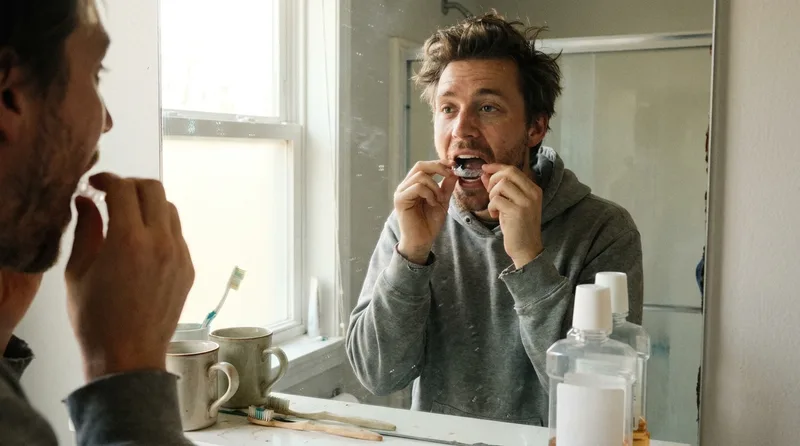
Invisalign treatment for adults typically takes 12 to 18 months for comprehensive cases, though mild cases can be resolved in as few as 6 months and more complex presentations may take longer. The timeline depends on the degree of movement needed, how consistently the aligners are worn, and whether refinements are required to finalize the result.
The single most important factor in keeping the treatment on schedule is wear time. Aligners should be worn 20 to 22 hours per day, which means they are out only for meals, snacks, and cleaning. Adults who wear their aligners consistently and advance through the series on schedule generally finish close to the projected completion date. Those who remove them frequently for comfort or convenience will see their treatment extend accordingly.
Research published in the orthodontic literature has found that aligners worn for fewer than 20 hours per day show a measurable reduction in tooth movement efficacy, with some studies finding that movement accuracy drops significantly at lower wear times, according to that research. The compliance requirement is the main trade-off adults should consider honestly before starting treatment.
Invisalign will require a few adjustments to daily routine, but for most adults the impact is far smaller than they anticipate. The main changes involve eating and cleaning habits, and both become second nature within the first week or two.
Aligners must be removed before eating or drinking anything other than plain water. This means carrying a case to store them during meals and brushing before reinserting. For adults who graze throughout the day, this adjustment is more significant than for those who eat at set mealtimes. Keeping the total time out of the mouth to under four hours per day is the practical goal.
Speech is briefly affected for some patients in the first few days as the tongue adjusts to the presence of the aligners. Most adults report that any noticeable lisp or change in articulation resolves quickly, typically within a week. This is worth knowing in advance for anyone with a presentation or important speaking engagement in the first days of treatment.
Aligner changes happen every one to two weeks, and check-in appointments with Dr. Curley are typically scheduled every six to eight weeks to monitor progress. For busy adults, the relatively infrequent in-office visits are often cited as one of the more appreciated aspects of the treatment compared to conventional braces, which require more frequent adjustments.
The process begins with a consultation including digital scans and a treatment simulation that previews the projected movement of your teeth before any aligners are made. Once the plan is approved, custom aligners are fabricated and delivered at a follow-up appointment.
The Invisalign process at Susan J. Curley DDS begins with a comprehensive consultation where Dr. Curley evaluates your teeth, takes digital scans, and discusses your goals. The scans are used to generate a digital treatment simulation that shows the projected movement of your teeth from start to finish, giving you a preview of the expected result before any aligners are made.
Once the treatment plan is approved, the custom aligners are fabricated and delivered at a follow-up appointment. Dr. Curley will review wear and care instructions and place any attachments on the teeth that are needed to guide specific movements. Each set of aligners is typically worn for one to two weeks before advancing to the next in the series.
According to the American Dental Association, patients considering orthodontic treatment should undergo a thorough dental evaluation first to ensure that teeth and gums are healthy enough to support tooth movement, which is exactly what the initial consultation at Susan J. Curley DDS provides.
To schedule a consultation, visit susanjcurleydds.com/book-appointment or call the office directly.

Whether Invisalign is worth it depends on what you want to change and how much the current state of your smile affects you. For adults who have tolerated crooked teeth because they assumed braces were behind them, Invisalign offers a genuine path that did not exist a generation ago.
Whether Invisalign is worth it depends on what you are looking to change and how much the current state of your smile is affecting you. For adults who have been tolerating crooked or gapped teeth for years because they assumed braces were behind them, or because they were unwilling to spend 18 months in visible metal brackets, Invisalign offers a genuine path forward that did not exist a generation ago.
The investment is comparable to conventional braces and reflects the fabrication of custom aligners, the clinical expertise involved in treatment planning and monitoring, and the convenience of the removable, nearly invisible format. Most patients who complete Invisalign treatment report that the outcome improved not just the appearance of their smile but their confidence in professional and social contexts, which is a return that is difficult to quantify but consistently cited.
The best way to know whether it is worth it for your specific situation is a consultation. Dr. Curley will give you an honest assessment of what Invisalign can achieve in your case, how long it is likely to take, and what the full picture looks like before you commit to anything.
Ready to find out if Invisalign is right for you?
Schedule a consultation at Susan J. Curley DDS in Wall Township, NJ. Dr. Curley will evaluate your teeth, show you a digital preview of your projected result, and give you a clear, honest recommendation.
Explore Our ServicesInvisalign for adults connects to broader smile goals that many patients pursue alongside or after orthodontic treatment.
Results may vary. Please consult with your dentist at Susan J. Curley DDS for personalized treatment recommendations.
Written By
Dentist
Temporary crown care tips: what to avoid eating, how to floss carefully, and what to do if it comes loose or falls off entirely.
Cost of veneers NJ: what actually drives the price, from the number of veneers to material choice and treatment planning.
Crown after root canal: why almost every treated tooth needs one, what happens if you skip it, and the right treatment timeline.
Book your visit with Dr. Curley online or call us, and we'll take it from there.