
Preventive Dentistry
Diet, Snacking, and Cavity Risk: What Actually Matters
Diet snacking cavity risk comes down to timing more than total sugar. Here's what actually matters between your dental cleanings.
Aug 5, 20269 min read



Dental sealants for kids are a thin protective coating painted onto the chewing surfaces of back teeth, and for most school-age children, they are worth it. Tooth decay is the most common chronic disease of childhood, five times more common than asthma. The molars where kids do most of their chewing are also the hardest teeth to clean with a toothbrush alone. This guide walks through what sealants actually do, how they compare to fillings on cost, which kids benefit most, and how Dr. Susan J. Curley approaches sealants as part of routine general dentistry for families in Wall Township.
Wondering If Your Child Needs Sealants?
Dr. Curley can check your child's molars at their next checkup and let you know if sealants make sense.
Book Appointment →Dental sealants are a thin plastic resin coating applied to the chewing surfaces of molars, filling in the deep grooves where food and bacteria collect. They act as a physical barrier, similar to a raincoat for a tooth, keeping cavity-causing bacteria out of pits a toothbrush bristle cannot fully reach.
Molars have narrow, uneven grooves that form during tooth development, and these grooves are often too tight for bristles or even floss to clean completely. According to the CDC, dental sealants can reduce the risk of cavities in school-age children by nearly 80% when applied soon after the permanent molars come in. That single number is the reason sealants show up in nearly every pediatric prevention guideline.
The coating itself is not a substitute for brushing. It targets one specific weak spot: the chewing surface where most childhood cavities actually start. Once placed, a sealant is nearly invisible in everyday use. It does not change how a tooth feels, looks, or bites down, and most kids forget it is even there within a day or two.

Yes, dental sealants are generally worth the cost, since they cost a fraction of what a filling for the same tooth would run, and they prevent a problem instead of repairing one. The math tends to favor prevention once you look at what a single cavity actually involves.
A filling means numbing the tooth, removing decayed structure, and placing a restoration that will eventually need replacement. A sealant takes a few minutes, needs no local anesthetic, and simply seals off the risk before decay ever starts. Many dental insurance plans also cover sealants for children at little to no out-of-pocket cost, which shifts the calculation further in their favor.
Where sealants are less clearly worth it: a tooth that already has a small cavity needs a filling instead, and an adult molar with a naturally shallow, easy-to-clean groove may not need one at all. Dr. Curley evaluates each tooth individually rather than sealing every molar automatically.
The permanent first and second molars benefit most from sealants, since their deep grooves make up the majority of cavities in school-age kids. These teeth typically erupt around ages 6 and 12, which is why pediatric guidelines suggest checking for sealant candidates at those specific ages rather than waiting for a problem to show up.
Not every molar has the same groove pattern. Some kids have shallow, wide grooves that a toothbrush cleans easily, while others have narrow, cup-shaped pits that trap food no matter how carefully a child brushes. A visual and tactile exam is the only reliable way to tell the difference, which is part of why sealant decisions are made tooth by tooth rather than as a blanket policy.
| Tooth | Typical Age | Sealant Priority |
|---|---|---|
| First permanent molars | Around age 6 | High |
| Second permanent molars | Around age 12 | High |
| Premolars | Ages 10 to 12 | Case by case |
| Baby molars | Already present | Sometimes, if deep grooves |
Front teeth almost never need sealants, since their flatter surfaces are already easy to keep clean with a toothbrush.
Dental sealants typically last several years, and many hold up well beyond that with normal wear from chewing. Regular checkups are how a chipped or worn sealant gets caught before decay has a chance to start underneath it.
Sealants do not fail all at once. Small chips can appear at the edges over time, especially on a child who grinds their teeth or chews ice. A worn section simply exposes that part of the groove again, rather than causing any sudden problem. This is why sealants get checked at every routine cleaning rather than being treated as a one-time, forget-it procedure.
If a sealant does wear down, reapplying it is quick and inexpensive compared to treating a cavity that develops in an unprotected groove. Kids who grind their teeth at night or chew on ice, pens, or fingernails tend to wear through sealants faster. Mentioning those habits at a checkup helps the team know which teeth to watch more closely.
Yes, applying dental sealants is safe and generally comfortable, since the process does not require numbing, cutting, or removing any tooth structure. Most kids sit through it without any complaints.
The tooth is cleaned and dried, a mild etching gel roughens the surface so the sealant bonds properly, and the liquid resin is then painted into the grooves and hardened with a curing light. The entire process for one tooth takes just a few minutes, and children can eat and drink normally right afterward.
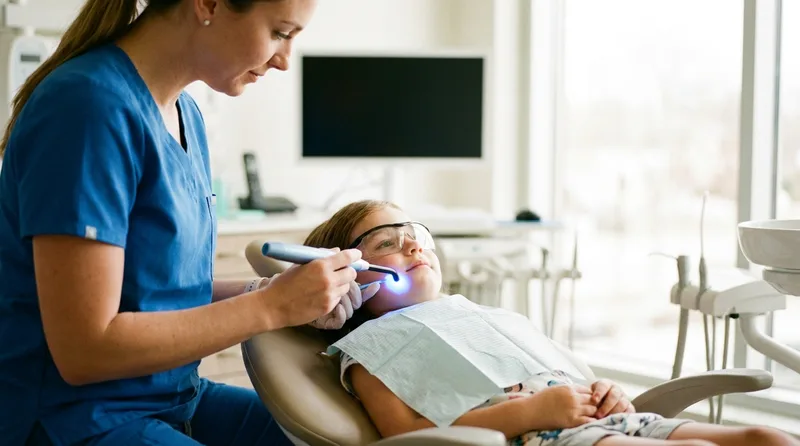
Because there is no local anesthetic involved, kids do not leave with a numb lip or cheek, which many parents appreciate for the ride home. Most children describe the etching gel as tasting slightly sour and the curing light as a brief warm sensation, neither of which causes any real discomfort.
New to the Practice?
If you're still deciding when to bring your child in for their first visit, our timeline guide walks through the milestones by age.
Read the Full Timeline →Sealants cost noticeably less than fillings on a per-tooth basis, and that gap grows once you factor in that a filled tooth often needs replacement or additional work over a lifetime. Prevention is simply the more affordable path in the long run.
A filling addresses damage that has already happened: decayed material has to be removed, and the resulting restoration is a repair, not a repair-proof guarantee. A sealant, by contrast, addresses risk before any damage occurs, which is inherently a smaller and simpler procedure. Many dental insurance plans cover sealants for children at little or no out-of-pocket cost specifically because insurers recognize this same math.
Ask about coverage details at your child's next visit. The team can check your specific plan and let you know what applies before any sealant is placed. Even for families without dental insurance, the relative cost of a sealant is still well below what a filling and its eventual replacement would add up to over the years a child keeps that tooth.
Your child likely needs sealants if their permanent molars have deep pits or grooves, if they have had cavities before, or if their brushing technique still needs improvement. A dental exam is the most reliable way to confirm which teeth qualify.
Not every child needs sealants on every molar. Dr. Curley checks each tooth at routine visits and only recommends sealants where the groove pattern and risk factors genuinely call for it. A brief visual exam and a dental instrument called an explorer are usually all it takes to make that call.
According to the CDC, roughly 20% of children ages 5 to 11 have at least one untreated decayed tooth. That statistic is part of why prevention-focused steps like sealants get recommended before problems show up. Catching a molar with high-risk grooves early is far simpler than treating a cavity that has already formed.
Yes, sealants and fluoride treatments protect teeth in different ways: sealants physically block the deep grooves of molars, while fluoride strengthens the enamel across the entire tooth surface. Most kids benefit from both, not one instead of the other.
Fluoride works at a chemical level, helping enamel resist acid attacks and even reverse very early decay before a cavity fully forms. It reaches every surface fluoride touches, including between teeth and along the gumline, areas a sealant never covers. According to MouthHealthy, the ADA's patient education site, sealants and fluoride are considered complementary parts of a complete prevention plan rather than substitutes for each other.
At a typical checkup, a child might receive a fluoride treatment at every visit while sealants are placed once, on specific molars, at specific ages. The two are usually recommended together rather than as a choice between them. Tooth decay remains the most common chronic disease of childhood, so a layered approach, fluoride plus sealants plus daily hygiene, tends to work better than relying on any single method alone.
No, sealants do not replace brushing and flossing, since they only protect the chewing surfaces of back teeth and leave every other surface exposed to plaque. Daily hygiene still does the rest of the work.
Tooth decay is the most common chronic disease in children nationwide, and sealants close one specific gap in an otherwise sound hygiene routine rather than replacing that routine entirely. Cavities between teeth, along the gumline, and on front teeth are unaffected by a sealant and depend entirely on brushing twice a day and flossing once a day. Regular checkups round out the picture by catching anything sealants and home care miss.
Think of sealants as one layer in a broader plan, not a stand-alone fix. The combination of sealants, home hygiene, and routine visits is what actually keeps a child's cavity risk low.
Dental sealants for kids are not a guarantee against every cavity, but for the right tooth at the right age, they are a low-cost, low-effort way to close off the single spot where most childhood decay begins. The real value of dental sealants for kids shows up over years, not on a single visit.
Results may vary. Please consult with your dentist at Susan J. Curley DDS for personalized treatment recommendations.
If your child is due for a checkup or you are not sure whether their molars qualify, the next step is simple: bring it up at their next visit.
Ready to Ask About Sealants?
Book an appointment with Susan J. Curley DDS and we'll check whether sealants are a good fit for your child's molars.
Book an Appointment →Prefer to talk it through first?
Call 732-681-8604 →Written By
Dentist
Diet snacking cavity risk comes down to timing more than total sugar. Here's what actually matters between your dental cleanings.
Dental abscess warning signs range from ordinary tooth pain to a true emergency. Here's exactly how to tell which one you have.
A knocked out tooth what to do checklist for the first 30 minutes matters more than almost anything else for saving it long term.
Book your visit with Dr. Curley online or call us, and we'll take it from there.