
Dental Implants
Dental Implants After 60: Healing and Candidacy Guide
Dental implants after 60 come with different healing and candidacy questions. Here's what actually changes, and why age alone rarely rules you out.
Aug 2, 20269 min read



One of the most common questions parents ask at an initial appointment is whether they brought their child in at the right time. The honest answer is that most children are brought in too late rather than too early, and the difference matters more than most parents expect. Understanding when should kids start going to the dentist by developmental stage, and what the dentist is looking for at each age, gives parents a clear answer to when should kids start going to the dentist and what to expect at each stage. Susan J. Curley DDS in Wall Township, NJ is a general and family dental practice that sees patients of all ages, and Dr. Curley treats children alongside adult patients in the same warm, unhurried environment.
The American Dental Association recommends a child's first dental visit by age one or within six months of the first tooth erupting. Early visits establish a dental home, allow monitoring of tooth development from the start, and give parents guidance on oral hygiene and feeding habits that prevent problems from developing.
The American Dental Association and the American Academy of Pediatrics both recommend that a child's first dental visit happen by age one or within six months of the first tooth erupting, whichever comes first. This timing surprises many parents who assume the dentist is only relevant once the full set of baby teeth is in place or when a visible problem appears.
According to the American Dental Association's MouthHealthy resource on baby teeth, early dental visits establish a dental home for the child, allow the dentist to monitor tooth development from the beginning, and give parents personalized guidance on oral hygiene, feeding habits, and pacifier or digit sucking practices that can affect tooth development. The first visit is as much for the parent as it is for the child.
At this age the visit is brief: a gentle examination of the erupted teeth and gums, a conversation about the child's feeding and oral habits, and guidance on how to clean baby teeth and what to expect as more come in. No X-rays, no drilling, no pressure. The primary goal is a positive first experience in a dental environment and an informed parent walking out the door.
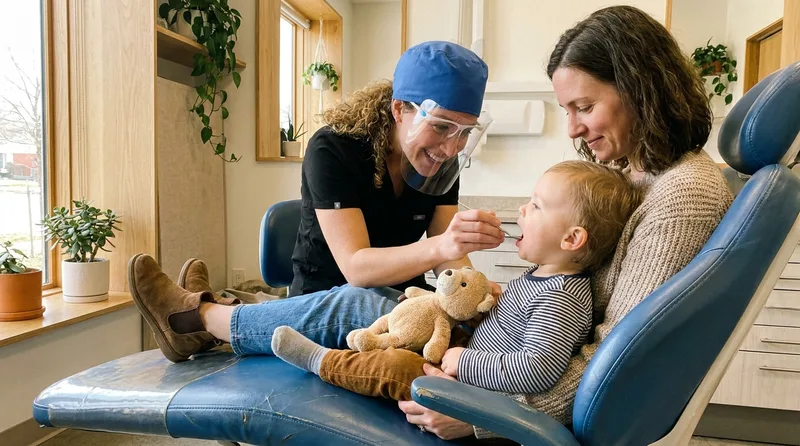
Once the first visit has happened, routine six-month visits are the standard through early childhood. During this period the primary teeth continue to erupt, the bite relationship begins to develop, and oral habits like thumb sucking and bottle use are actively discussed.
Baby bottle tooth decay, also called early childhood caries, is one of the most common preventable childhood diseases and develops rapidly in toddlers who fall asleep with a bottle containing milk or juice, or who have prolonged exposure to sugary drinks throughout the day. It typically affects the upper front teeth first and can progress from a small white spot to a cavity requiring a filling or extraction within months. Regular dental visits in this age range catch these early lesions when they are still small and manageable.
A child who visits the dentist every six months starting in early toddlerhood develops familiarity with the environment and the routine that prevents dental anxiety from developing. The child who has their first dental visit at age seven because a tooth hurts has a fundamentally different and typically more difficult first dental experience than the child who has been coming in since age one and knows exactly what to expect.
Between ages three and six, the full primary dentition is typically present and the first permanent molars are developing beneath the gum. Dentists monitor bite development, look for early crowding patterns, reinforce home hygiene habits, and apply fluoride varnish to reduce cavity risk in higher-risk children.
Between ages three and six, the full set of twenty primary teeth is typically present and the first permanent molars are beginning to develop beneath the gum. This period is important for monitoring bite development, identifying any crowding patterns that may indicate future orthodontic needs, and reinforcing oral hygiene habits that the child is now old enough to participate in actively.
Fluoride varnish applications at dental visits in this age range significantly reduce the risk of early childhood cavities in higher-risk children, and X-rays are introduced when there are teeth with contacts between them that cannot be visualized clinically. The X-rays used for children are limited to what is clinically indicated rather than routine, and the radiation exposure from modern digital dental X-rays is minimal.
This is also the age range when parents typically begin to worry about thumb sucking or pacifier use and whether these habits are affecting the teeth. The dentist monitors the bite at each visit and advises on timing and approach based on what is actually observed clinically rather than general timelines. Our article on how to choose a family dentist covers what makes a practice well suited to seeing children of all ages alongside their parents.
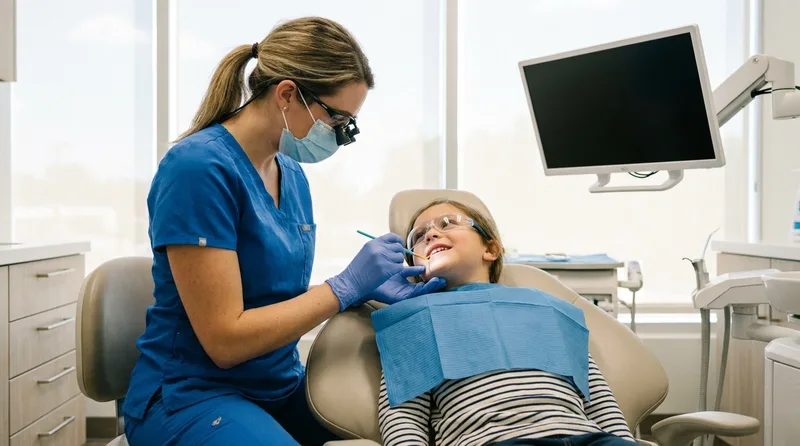
The mixed dentition phase is when baby teeth fall out and permanent teeth erupt in a sequence affecting the developing bite. The first permanent molars erupt around age six and are the most cavity-prone teeth in the mouth due to their deep grooves. Sealants applied at eruption reduce their decay risk by approximately 80%, according to ADA data.
The mixed dentition phase, roughly ages six through twelve, is one of the most important periods for dental monitoring. Baby teeth are falling out and permanent teeth are erupting in a sequence that affects the developing bite. The first permanent molars erupt around age six and are among the most cavity-prone teeth in the mouth because of their deep grooves and the fact that children are typically not brushing them effectively yet.
Dental sealants applied to the chewing surfaces of the first permanent molars when they erupt are one of the most effective preventive interventions in dentistry. Sealants fill the deep grooves where most cavities start, creating a smooth surface that is far easier to clean. They are quick, painless, and require no anesthesia. The second permanent molars erupt around age twelve and are the second appropriate time for sealant application.
Orthodontic evaluation is typically recommended around age seven to assess whether bite discrepancies, crowding, or jaw development patterns warrant early intervention. Dr. Curley monitors these factors at each dental visit and refers to an orthodontist when the timing and clinical picture support early treatment, or advises observation when early intervention would not change the eventual outcome.
According to the American Dental Association, dental sealants applied to permanent molars reduce the risk of cavities in those teeth by approximately 80% compared to unsealed molars, according to published preventive dentistry data, making them one of the most cost-effective interventions available in childhood dentistry.
Adolescence introduces sports participation, ongoing orthodontic treatment, wisdom tooth development, and dietary shifts toward acidic beverages and snack foods that increase cavity risk. All of these are monitored and addressed at routine dental visits for patients who have established a consistent dental home.
Adolescence introduces new oral health challenges that routine dental visits are well positioned to address. Sports participation makes athletic mouthguards relevant for protecting permanent teeth during contact sports. Orthodontic treatment, when it is ongoing, requires more frequent monitoring of oral hygiene around brackets and wires. Wisdom teeth begin to develop and can be identified on X-rays well before they cause symptoms, allowing for planned evaluation rather than reactive treatment.
Dietary habits shift significantly in adolescence, often toward more acidic and sugary beverages, energy drinks, and snack foods that increase cavity risk. Teenagers who have been attending dental visits since early childhood have an established relationship with the dental team that makes these conversations more effective than they would be with an unfamiliar provider at an unfamiliar practice.
Published research has found that children who establish consistent dental care early and maintain six-month visits throughout childhood have significantly lower rates of untreated tooth decay in adolescence and adulthood compared to those who receive episodic or reactive care, according to published longitudinal oral health data. The pattern of care established in childhood is among the strongest predictors of adult oral health outcomes.

Yes. Susan J. Curley DDS is a general and family dental practice that welcomes patients of all ages, from toddlers through adults. Children and adult patients are seen in the same warm environment, helping normalize dental care as routine health maintenance rather than a specialized or intimidating experience.
Yes. Susan J. Curley DDS is a general and family dental practice that sees patients of all ages, from toddlers through adults. Children are seen in the same environment as adult patients, which helps normalize dental care as a routine part of health maintenance rather than a specialized or intimidating experience. Families often have multiple generations seen at the same practice, and Dr. Curley maintains a complete picture of the family's dental history that informs care for each member.
New patient appointments for children at Susan J. Curley DDS follow the same structure as described above for the relevant age: brief for very young children, more comprehensive as children grow and more clinical data becomes relevant. To schedule your child's first visit or to move the whole family to Susan J. Curley DDS, visit susanjcurleydds.com/book-appointment or contact the office at susanjcurleydds.com/contact.
Ready to bring your child in?
Susan J. Curley DDS welcomes children and families in Wall Township, NJ. Book your child's first visit or schedule the whole family at once.
General Dentistry ServicesFamily dental care at Susan J. Curley DDS spans patients of all ages and connects to several related topics.
Results may vary. Please consult with your dentist at Susan J. Curley DDS for personalized treatment recommendations.
Written By
Dentist
Dental implants after 60 come with different healing and candidacy questions. Here's what actually changes, and why age alone rarely rules you out.
Your periodontal maintenance cleaning schedule changes after gum treatment. Here's why the 3 to 4 month recall matters, and what happens if you skip it.
Guided biofilm therapy Wall Township NJ patients ask about: how it compares to a traditional cleaning, and which one your gums actually need.
Book your visit with Dr. Curley online or call us, and we'll take it from there.