smile-design
Your First Smile Makeover Consultation: What to Expect
Your first smile makeover consultation: what to expect, from the goals discussion to your digital smile design preview and plan.
Sep 20, 20268 min read



Dental implants after 60 raise a specific worry for a lot of patients: does age itself close the door on this particular option? For most healthy older adults, the answer is no. A 2025 systematic review found no significant difference in implant success rates between patients averaging 65 to 75 years old and older cohorts, including patients over 75. What actually changes isn't whether implants can work. It's how healing, planning, and candidacy get evaluated along the way.
Susan J. Curley DDS handles the restorative side of implant treatment, the crown that completes your smile once your implant has healed, working alongside the specialist who places the implant surgically. 42% of adults aged 30 and older have some form of periodontal disease, one of the leading causes of the tooth loss that eventually brings patients to consider implants in the first place. Here's what actually changes about candidacy and healing after 60, and what doesn't.
No, age alone rarely disqualifies someone from dental implants. What matters far more is bone quality, overall health, and how well any existing conditions are managed, not the number on your birth certificate.
A systematic review and meta-analysis comparing implant survival in patients averaging 65 to 75 years against older cohorts found no significant difference in success rates, concluding that dental implants are a reliable treatment for older adults, including those over 75. Peri-implant bone remained stable even though plaque and bleeding on probing showed up slightly more often in the older group. That's a meaningful distinction: more frequent minor findings during checkups, not a fundamentally different outcome. Researchers noted this held true even in patients who had never had an implant before, not just those replacing an older, failing one.
Where age does play a role is in planning. Your dentist will look more closely at bone density, medication history, and healing capacity before recommending a path forward. Not a red flag. Just a more thorough workup than a 30-year-old with no medical history would typically need.
Healing after 60 tends to take somewhat longer because bone remodeling and tissue regeneration naturally slow with age. Most patients still heal well; the timeline just needs more patience than it might have at 35.
Osseointegration, the process where bone fuses to the implant, is what determines whether an implant becomes a stable, permanent part of your jaw. In younger patients this process often completes in three to four months. Past 60, five to six months isn't unusual, particularly in the lower jaw where bone density tends to be lower than in the upper jaw. Your surgical specialist will confirm healing with imaging before your restoration moves forward, not just a calendar date.
Certain habits speed healing regardless of age: not smoking, keeping blood sugar controlled if you have diabetes, and following the post-surgical care instructions exactly as given. These matter more at 65 than they did at 35, simply because there's less biological margin for error.
Yes, lower bone density can affect implant candidacy, but it's a planning consideration rather than an automatic disqualifier. Bone grafting and alternative implant designs address low density in the large majority of cases.
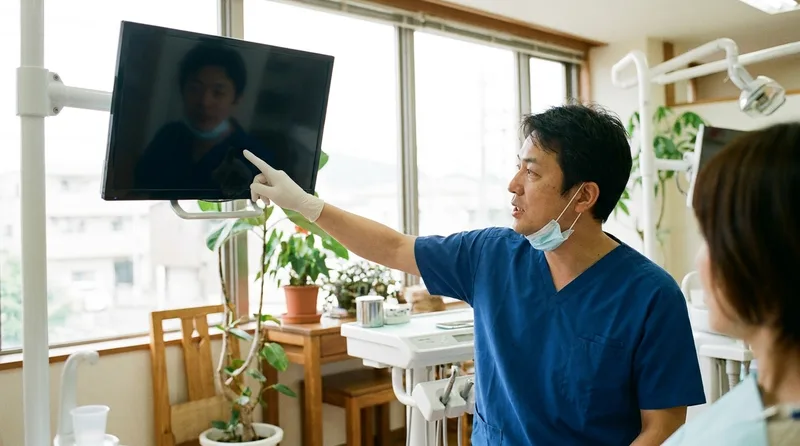
Bone density naturally peaks between ages 25 and 35 and gradually declines afterward, and missing teeth accelerate that decline in the jaw specifically, since the bone loses the stimulation it needs from tooth roots. Women tend to lose bone density faster after menopause. None of that means implants are off the table. It means your specialist may recommend a bone graft, a different implant length or width, or additional imaging to map out exactly where bone is sufficient. A cone-beam CT scan gives a precise 3D picture before anyone commits to a plan.
The honest answer is that most candidacy concerns tied to bone density get resolved with planning, not ruled out entirely.
Diabetes and osteoporosis can influence healing, but neither one automatically rules out dental implants when the condition is well managed. Control matters far more than the diagnosis itself, and both conditions are common enough in patients over 60 that most implant specialists plan around them routinely rather than treating them as exceptions.
A 2025 meta-analysis focused specifically on osteoporosis found that osteoporosis alone does not compromise implant outcomes, supporting safe, predictable implant therapy in older adults when treatment is individually planned. Patients on certain osteoporosis medications, particularly some bisphosphonates, do need extra evaluation before surgery, since those medications can affect how bone heals around an implant. This is exactly the kind of detail your specialist reviews during a full medical history.
Diabetes works similarly. Well-controlled blood sugar supports normal healing. Poorly controlled diabetes slows healing and raises infection risk, which is why your dentist and physician often coordinate before moving forward. It's rarely a yes-or-no answer. It's a "let's get this managed first" conversation.
Neither option is universally better after 60; the right choice depends on your bone health, budget, and how much stability you want day to day. Implants generally offer more stability and a more natural feel, while dentures involve less upfront treatment and lower initial cost. Both remain solid choices when matched correctly to the patient.
Our comparison of dentures versus dental implants covers the tradeoffs in more depth, but a few age-specific points are worth calling out here. Implants preserve jawbone by continuing to stimulate it the way natural tooth roots did, which dentures can't replicate. That matters more the longer you expect to wear a replacement. On the other hand, if bone density is significantly reduced or a medical condition makes surgery riskier, dentures remain a reliable, lower-intervention option.
Consider whether these describe your priorities:
Not sure which option fits your situation?
Dr. Curley can review your bone health and medical history to help you weigh implants against dentures honestly.
Request an Appointment →The dental implant process involves a surgical placement phase, a healing period, and a restorative phase where the visible crown is attached. At Susan J. Curley DDS, we coordinate the surgical portion with a trusted specialist and handle the restorative crown once you've healed and your specialist has confirmed the implant is ready.
Here's the general sequence patients go through:
Splitting surgical placement and restorative care between a specialist and your general dentist is standard practice, not a compromise. It means the person handling the surgical side is focused entirely on that skill, while the person handling your crown is focused on matching it precisely to your bite and smile. Most patients find this coordination seamless once it's explained, since both providers share imaging and treatment notes throughout.
Healing for older patients typically takes four to six months before the crown restoration can be placed, compared to three to four months for younger patients. Individual healing speed varies more with overall health than with age alone.
| Factor | Under 60 | Over 60 |
|---|---|---|
| Typical osseointegration time | 3 to 4 months | 4 to 6 months |
| Imaging checkpoints | Usually one confirmation scan | Often one or two confirmation scans |
| Bone graft likelihood | Lower, unless teeth were missing long-term | Somewhat higher due to natural bone density decline |
| Success rate | High, comparable across healthy patients | High, comparable across healthy patients |
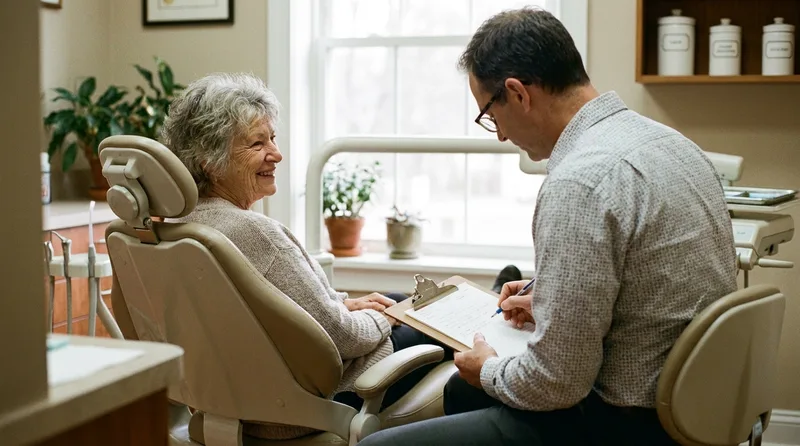
Your specialist won't guess when healing is complete. Imaging confirms that the implant has properly fused to the bone before the restorative phase begins, which protects the long-term success of the whole treatment. Rushing this step is one of the more common causes of implant failure at any age, and it's not worth trading a few extra weeks of patience for a problem down the road.
Most patients find the wait easier when they know exactly what's happening at each stage, rather than treating it as an open-ended timeline with no checkpoints. A short conversation with your specialist about what each imaging checkpoint is actually looking for tends to ease most of the uncertainty.
Original Medicare generally does not cover dental implants, since routine dental care falls outside its standard coverage entirely. Some Medicare Advantage plans include dental benefits that may cover part of the cost, and private dental insurance often covers a portion as well.
Coverage details vary widely between plans, and implants are frequently split into separate billed components: the surgical placement, any bone grafting, and the restorative crown. Some plans cover the restorative portion more generously than the surgical portion, or vice versa, which can make the total out-of-pocket estimate confusing without a direct conversation with your provider. It's worth asking specifically how your plan categorizes each phase before treatment begins, rather than assuming one quoted number covers everything.
The team at Susan J. Curley DDS reviews your specific benefits for the restorative portion of treatment and can help you understand what to expect before committing to a plan. We can also point you toward questions worth asking the surgical specialist's office about their portion of the coverage. It's worth noting that Americans who visit a dentist regularly are 60% less likely to lose teeth in the first place, according to the Journal of Dental Research, which underscores why staying on top of maintenance care matters just as much after your implant heals.
Ready to find out if you're a candidate?
Dr. Curley can walk you through candidacy, timeline, and cost honestly, with no pressure either way.
Book Appointment →Dental implants after 60 come down to the same fundamentals that matter at any age: bone health, how well any medical conditions are managed, and realistic expectations about the timeline. Age by itself rarely closes the door, and the research backs that up more consistently than most patients expect walking in. The honest starting point is a real evaluation of your bone density and health, not an assumption based on a birthday. Results may vary. Please consult with your dentist at Susan J. Curley DDS for personalized treatment recommendations.
Wondering if you're a candidate for dental implants?
Schedule a consultation with Dr. Curley to get a real answer based on your bone health and history, not your age.
Book Appointment →Curious about the cost breakdown?
See what drives dental implant cost in NJ →Written By
Dentist
Your first smile makeover consultation: what to expect, from the goals discussion to your digital smile design preview and plan.
What is digital smile design? A preview technology that lets you see your proposed new smile before treatment even begins.
Am I a candidate for veneers? Six clear signs that suggest veneers could be a good fit for your smile and long-term goals.
Book your visit with Dr. Curley online or call us, and we'll take it from there.