crowns
Temporary Crown Care Tips: What to Avoid Before Your Crown
Temporary crown care tips: what to avoid eating, how to floss carefully, and what to do if it comes loose or falls off entirely.
Sep 13, 20269 min read


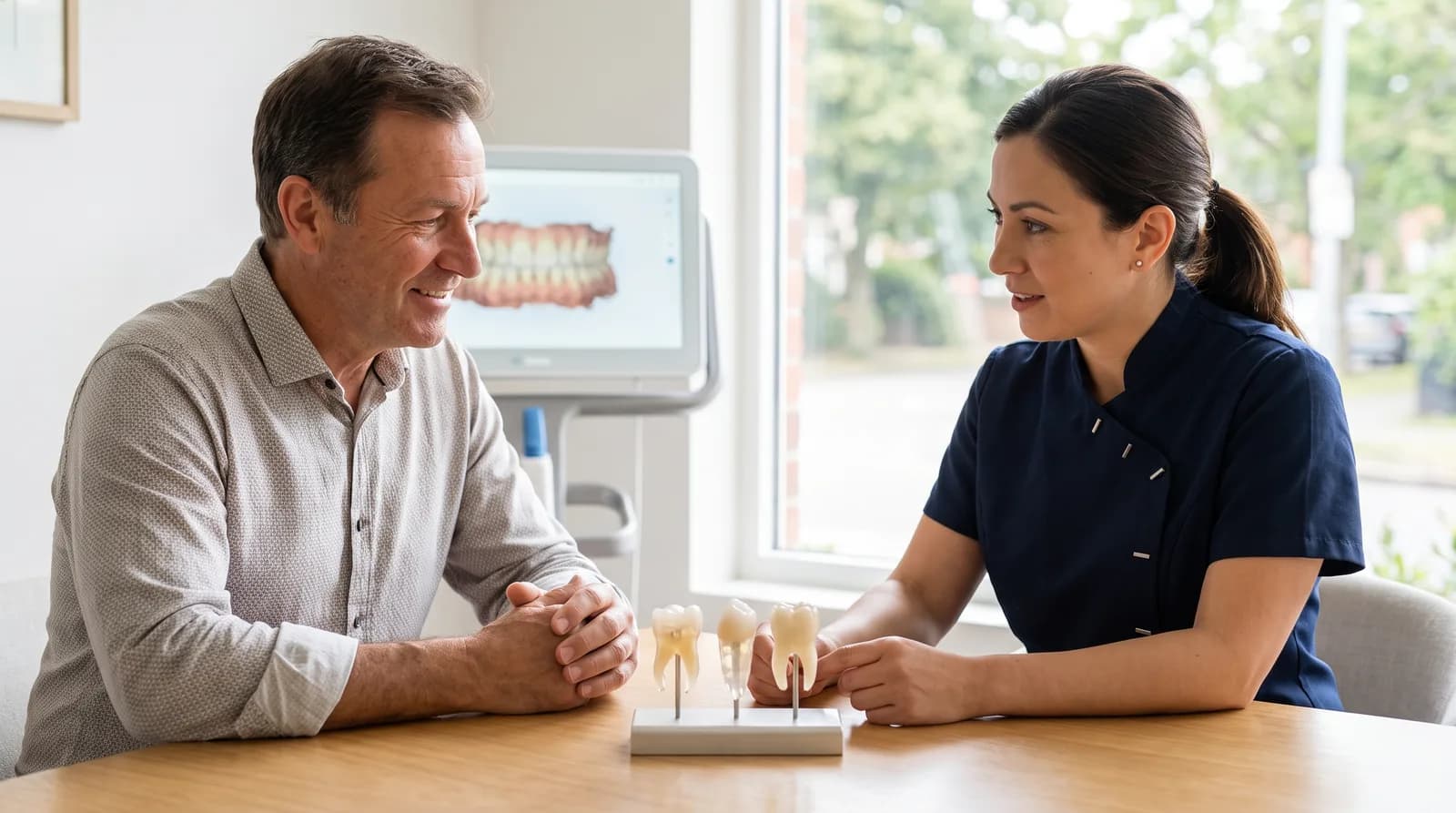
Getting a dental implant in Wall Township, NJ involves more than a single appointment. The dental implant process at Susan J. Curley DDS is a five-stage journey and understanding the dental implant process from start to finish helps patients know exactly what to expect. is a coordinated two-stage journey: a specialist periodontist surgically places the implant fixture into the jaw, and Dr. Curley designs and delivers the final crown that sits on top. Understanding this division of expertise, and what happens at each stage, helps patients know exactly what to expect from consultation through final restoration.
This collaboration is not a workaround; it is the optimal model for implant care. The periodontist brings specialized surgical expertise to the placement phase, and Dr. Curley brings her cosmetic and restorative background to the crown phase, ensuring the final tooth looks and functions precisely as intended within the context of your full smile.
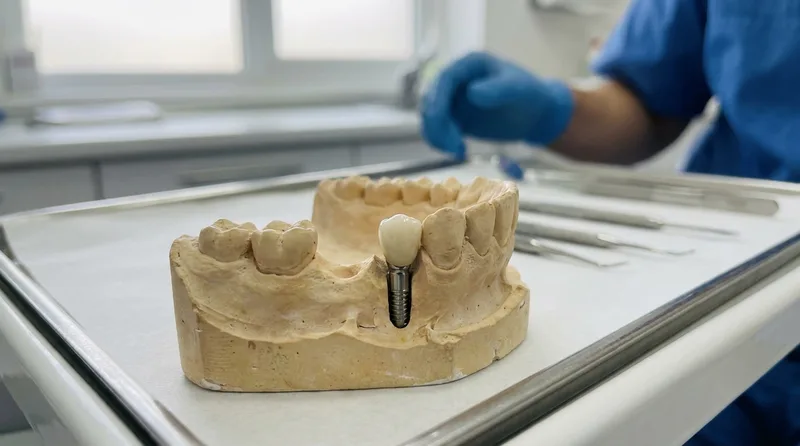
A dental implant is a titanium post surgically placed into the jawbone to replace a missing tooth root. Once the bone fuses around it, a custom crown attaches on top to restore the visible tooth, function, and appearance.
A dental implant is a titanium post that is surgically placed into the jawbone to serve as a replacement tooth root. Over a period of months, the bone grows around the post in a process called osseointegration, fusing it permanently into the jaw. Once integrated, the implant provides a stable foundation for a crown, bridge, or other restoration that sits above the gumline and functions like a natural tooth.
The implant itself has three components: the titanium fixture placed in the bone, the abutment that connects the fixture to the restoration, and the crown that is visible above the gum. Each component is critical to the overall outcome, which is one reason the surgical and restorative phases benefit from dedicated specialist expertise at each stage.
According to the American Dental Association's MouthHealthy resource on dental implants, implants are considered the closest available replacement to natural teeth in terms of function, appearance, and bone preservation. A systematic review published in peer-reviewed dental literature found implant survival rates exceeding 95% at 10 years, according to that research, making them one of the most durable tooth replacement options available.
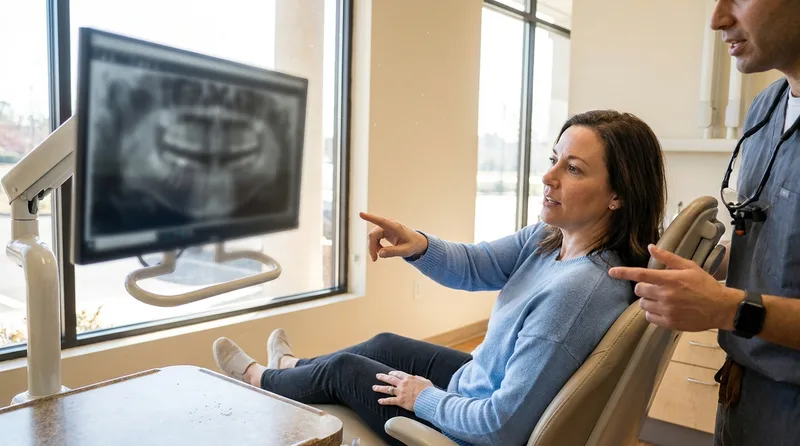
The dental implant process begins with a consultation at Susan J. Curley DDS, where Dr. Curley evaluates your oral health, discusses your goals, reviews your medical history, and determines whether you are a candidate for implant treatment. This first appointment is primarily diagnostic and educational. No procedures are performed, and it establishes the full treatment plan before any work begins.
During the consultation, Dr. Curley will:
Patients who need bone grafting before implant placement, because there is insufficient bone volume at the site, will also have that conversation here, since grafting adds a healing phase before the implant can be placed.
Once the treatment plan is finalized, Dr. Curley coordinates the referral to a trusted periodontist who performs the surgical placement. A periodontist is a dental specialist with three additional years of training beyond dental school focused on the tissues surrounding the teeth, including the bone and gum, which makes them the appropriate specialist for the surgical phase of implant treatment.
The placement procedure is performed under local anesthesia and is typically completed in under an hour for a single implant. The periodontist makes a small incision in the gum, prepares the bone site, and places the titanium fixture to the precise depth and angle that has been planned. The gum is then sutured closed over or around the implant, and the healing phase begins.
According to WebMD, most patients report that implant placement is more comfortable than they expected, with post-procedural soreness typically manageable with prescribed pain relief in the first few days.
Dr. Curley receives a detailed report from the periodontist after placement so she can track the case and plan the restorative phase with accurate information about the implant's position, depth, and angulation.
After placement, the implant undergoes osseointegration, in which the surrounding bone gradually bonds to the titanium surface. This phase typically takes three to six months and must complete fully before the restorative phase can begin.
After placement, the implant enters a healing phase called osseointegration, during which the surrounding bone gradually bonds to the titanium surface. This process typically takes three to six months, though the exact duration depends on the patient's bone density, overall health, and whether any bone grafting was performed. Osseointegration cannot be rushed; it is a biological process that must complete fully before the restoration phase can begin.
During this period, patients return to Dr. Curley's office for periodic check-ins to monitor healing progress. If a tooth was extracted at the same time as implant placement, a temporary restoration may be placed to maintain appearance and function in the interim. Most patients are able to eat and speak normally throughout the healing phase, with some restrictions on very hard or crunchy foods near the implant site.
The periodontist may also schedule follow-up appointments during this phase to confirm the implant is integrating as expected. Clear communication between the two practices throughout this stage is part of what makes the collaborative model effective.
Once osseointegration is confirmed via X-ray, Dr. Curley takes over for the restorative phase. The first restorative appointment involves placing the abutment, a small connector piece that attaches to the top of the implant fixture and protrudes through the gumline to provide the surface onto which the crown will be seated.
At this same appointment or a following one, Dr. Curley takes impressions or digital scans of the implant site and surrounding teeth. These records are sent to the dental laboratory, where the custom crown is fabricated to the exact specifications of your bite, jaw, and adjacent teeth. Dr. Curley selects the crown shade to match the surrounding natural teeth, applying the same cosmetic eye she brings to all restorative work.
The crown fabrication typically takes one to two weeks in the laboratory. During this time, a temporary crown is often placed to protect the abutment and maintain the space.
The final appointment is the crown delivery, the moment the implant journey comes together into a finished, functional tooth. Dr. Curley seats the permanent crown onto the abutment, verifies the fit, checks the bite carefully in all directions, and makes any final adjustments needed to ensure the crown integrates seamlessly with the surrounding teeth.
The result is a tooth that looks, feels, and functions like a natural one. Unlike a bridge, the implant crown does not rely on adjacent teeth for support and does not require those teeth to be prepared or altered. Unlike a denture, it is permanently fixed and transmits chewing forces directly into the bone, helping to preserve the bone volume at the site over time. Studies show that implant-supported restorations preserve significantly more bone than removable dentures, with some research finding up to 25% less bone resorption at implant sites over 5 years, according to clinical bone loss studies.
Dr. Curley will review care instructions and schedule a follow-up to confirm everything is settling as expected. Implants require the same daily brushing and flossing as natural teeth, along with regular professional cleanings and checkups. With proper maintenance, the implant fixture itself is designed to last a lifetime.
Good candidates for dental implants are adults with adequate bone volume at the implant site, healthy gums, and no uncontrolled systemic conditions that significantly impair healing. Most healthy adults who are missing one or more teeth qualify, and many patients who have experienced some bone loss can still proceed with implants after bone grafting to rebuild the site.
Factors that require additional evaluation include uncontrolled diabetes, which impairs healing and increases infection risk; heavy smoking, which significantly reduces implant success rates; active gum disease, which should be treated before any implant surgery; and certain medications that affect bone metabolism. None of these are automatic disqualifiers, but they affect the planning and timing of treatment. The consultation with Dr. Curley is where these factors are assessed honestly and candidacy is determined.
Patients who have been told they are not candidates for implants due to bone loss should be aware that bone grafting has made implant treatment accessible to many patients who previously could not proceed. A current evaluation with three-dimensional imaging is the only reliable way to know what is possible in your specific case.

Implant placement and restorative crown delivery are two distinct skill sets. A specialist periodontist brings surgical precision to the placement phase; Dr. Curley brings her cosmetic and restorative expertise to the final crown, ensuring the result integrates seamlessly into the full smile.
The surgical placement of a dental implant and the cosmetic restoration of the final crown are two genuinely distinct skill sets. A periodontist who places hundreds of implants per year brings a level of surgical precision that a general or cosmetic dentist placing occasional implants simply cannot replicate. Similarly, Dr. Curley's focus on the cosmetic and functional outcome of the final crown, integrated into the full context of your smile, is where her expertise is most valuable.
This model means patients at Susan J. Curley DDS receive specialist-level care at every phase of the implant process, not a compromise where one provider attempts to do everything. The coordination between the two practices is seamless from the patient's perspective: Dr. Curley manages the overall treatment plan, makes the specialist referral, monitors the healing phase, and delivers the final restoration. The patient's experience is that of a single coherent journey, supported by two experts each focused on their part of it.
To begin the process, schedule a consultation at Susan J. Curley DDS. Call the office or visit susanjcurleydds.com/book-appointment to request an appointment.
Ready to explore dental implants?
Schedule a consultation at Susan J. Curley DDS in Wall Township, NJ. Dr. Curley will evaluate your candidacy, explain the full process, and outline the collaborative care plan that gets you to a finished result.
Learn About Restorative DentistryDental implants connect to several other areas of care at Susan J. Curley DDS. The articles below go deeper on related topics.
Results may vary. Please consult with your dentist at Susan J. Curley DDS for personalized treatment recommendations.
Written By
Dentist
Temporary crown care tips: what to avoid eating, how to floss carefully, and what to do if it comes loose or falls off entirely.
Cost of veneers NJ: what actually drives the price, from the number of veneers to material choice and treatment planning.
Crown after root canal: why almost every treated tooth needs one, what happens if you skip it, and the right treatment timeline.
Book your visit with Dr. Curley online or call us, and we'll take it from there.