crowns
Temporary Crown Care Tips: What to Avoid Before Your Crown
Temporary crown care tips: what to avoid eating, how to floss carefully, and what to do if it comes loose or falls off entirely.
Sep 13, 20269 min read



Before scheduling a smile makeover consultation, most patients have one question that is hard to get a straight answer to: what is this actually going to cost? The honest answer is that smile makeover cost factors vary enough between cases that quoting a single number without evaluating the patient is not just unhelpful, it is misleading. But that does not mean the question is unanswerable. There are specific, concrete smile makeover cost factors that determine where a case falls on the investment range, and understanding those factors before your consultation gives you a realistic framework for the conversation.
At Susan J. Curley DDS in Wall Township, NJ, Dr. Curley provides clear, itemized cost estimates as part of every cosmetic consultation, so patients leave with a specific number rather than a vague range.
The number of teeth being treated is the most direct smile makeover cost factor. Each tooth receiving a veneer, crown, or bonding restoration adds to the total. The typical cosmetic zone spans six to ten upper front teeth, and limiting scope to the most visible teeth is the most common way to manage the investment.
The number of teeth being treated is the most direct cost driver in any smile makeover. A cosmetic plan addressing two front teeth involves different clinical work, different material costs, and different chair time than one addressing eight or ten teeth across the full smile zone. Each tooth that receives a veneer, crown, or bonding restoration adds to the total, so the scope of the plan is the first and most significant variable in the final investment.
The typical cosmetic zone for a smile makeover spans the upper front teeth visible when smiling, usually six to ten teeth depending on how wide the smile is and how much is visible. Limiting the scope to the most visible teeth rather than extending to every tooth is one of the most common ways patients and clinicians manage the investment while still achieving a meaningful result. Where the boundaries are set is a clinical and aesthetic judgment made in consultation, not a predetermined package.
Different cosmetic procedures involve different levels of clinical work and different material costs, and the right combination depends on what the teeth actually need rather than a standard package applied uniformly.
Procedures that commonly make up a smile makeover at Susan J. Curley DDS, roughly ordered from lower to higher per-tooth investment:
According to the American Dental Association's MouthHealthy resource, composite bonding requires replacement approximately every 5 to 10 years on average, compared to 10 to 20 years for porcelain veneers, according to published longevity data. Cosmetic procedures including veneers should be preceded by a thorough oral health evaluation, since no cosmetic result is durable on a foundation of untreated decay or gum disease. Addressing those issues adds to the total investment but is a clinical prerequisite, not an optional addition.

Material choice is a significant smile makeover cost factor because different ceramics carry different laboratory fabrication costs. Layered feldspathic porcelain provides the highest translucency but is more expensive. Monolithic zirconia is more economical and stronger but less translucent, suiting posterior teeth better than front teeth.
Material choice affects both the aesthetic result and the cost. For veneer and crown work, the material selected (lithium disilicate, layered porcelain, monolithic zirconia, or composite) carries different laboratory fabrication costs and different aesthetic properties. Layered feldspathic porcelain provides the highest level of translucency and natural appearance but is more technique-sensitive and typically more expensive than pressed ceramics. Monolithic zirconia is stronger and more economical but less translucent, making it more appropriate for posterior teeth than front teeth in most cases.
For bonding, composite resin is far less costly than ceramic but has a shorter lifespan and greater susceptibility to staining. The right material for any given tooth and situation is a clinical decision based on where the tooth is, what forces it takes, what the aesthetic goals are, and how the patient values durability versus upfront investment. Dr. Curley explains these trade-offs clearly during the consultation so patients can make an informed choice.
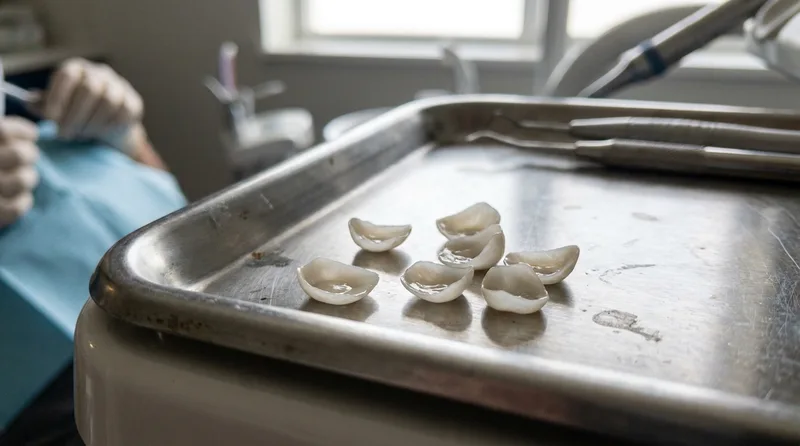
More complex cases require more clinical time and preparatory work before cosmetic procedures begin. Existing decay, gum disease, bite issues, and failing restorations must be addressed first, adding to the total investment but forming the clinical foundation that determines whether the cosmetic result lasts.
More complex cases require more clinical time and often more preparatory work before cosmetic procedures begin. A patient with healthy, well-aligned teeth and only color and minor shape concerns has a straightforward path to a veneer result. A patient with significant size discrepancies between teeth, gum tissue irregularities, a misaligned bite, or old restorations that need replacing first has more variables to address before the cosmetic work can deliver a lasting result.
Preparation work that adds to the total investment includes: treating existing decay or gum disease that must be resolved before cosmetic procedures begin; extracting or restoring failing teeth that would otherwise compromise the final result; bite adjustment or equilibration to ensure forces are distributed correctly across the new restorations; and the diagnostic wax-up or digital smile design planning process. None of these are padding; they are the clinical foundation that determines whether the cosmetic result lasts.
According to the American Dental Association, research on veneer longevity shows that survival rates exceed 90% at 10 years when cases are appropriately selected and prepared, according to published data. Proper case selection and preparation are among the most significant predictors of long-term cosmetic restoration success.
Cosmetic dental procedures are generally not covered by dental insurance since they are elective. However, components with a functional rationale, such as a crown on a structurally compromised tooth, may qualify for partial coverage. The team reviews benefits before treatment begins and identifies any eligible components.
Cosmetic dental procedures are generally not covered by dental insurance, since they are elective rather than medically necessary. However, some components of a smile makeover may have partial coverage if they have a functional rationale alongside the cosmetic one. A crown placed on a structurally compromised tooth, for example, may be partially covered even when that tooth is also in the cosmetic zone. Orthodontic coverage applies to alignment work regardless of whether the motivation is cosmetic.
At Susan J. Curley DDS, the team reviews insurance benefits before treatment begins and identifies any components that qualify for coverage under the patient's specific plan. Financing options are available for the remaining balance, allowing the investment to be spread across monthly payments. The goal is that patients have a clear picture of their actual out-of-pocket exposure before committing to any treatment, not after.

Whether a smile makeover is worth the investment is a personal question only the patient can answer, but the patients at Susan J. Curley DDS who complete cosmetic treatment consistently report that the result affected not just how their smile looked but how they felt in professional and social settings. The functional benefits of well-fitted restorations, including a corrected bite and properly contoured teeth, add a layer of value beyond the aesthetic.
The most useful framing is not whether a smile makeover is expensive in absolute terms. According to survey data on cosmetic dental patients, approximately 95% of patients who completed veneer treatment reported they would recommend the procedure to others, according to that patient satisfaction research. Whether the specific changes it would make to your smile are changes you value is the more useful question. A consultation makes that evaluation concrete rather than hypothetical, because it replaces the question of what something might cost with a specific plan, a specific result preview, and a specific number.
A cosmetic consultation at Susan J. Curley DDS begins with a full oral health evaluation, followed by a review of cosmetic goals and a digital smile design preview of the proposed outcome. By the end, patients have a specific itemized plan with costs for each component, a timeline, and no obligation to commit on the day.
A cosmetic consultation at Susan J. Curley DDS begins with a full oral health evaluation to establish what conditions, if any, need to be addressed before cosmetic work begins. Dr. Curley then reviews your cosmetic goals, takes clinical photographs, and walks through the procedures that would address your specific concerns. The digital smile design process provides a visual preview of the proposed outcome before any commitment is made.
By the end of the consultation, you will have a specific, itemized treatment plan with costs for each component, a timeline for sequencing the work, and a clear understanding of which elements are prerequisites versus which are optional enhancements. There is no pressure to commit at the consultation, and the estimate is yours to review and consider at your own pace.
To schedule a smile makeover consultation, visit susanjcurleydds.com/book-appointment or call the office directly.
Ready to find out what your smile makeover would cost?
Book a cosmetic consultation at Susan J. Curley DDS in Wall Township, NJ. Dr. Curley will evaluate your teeth, preview the proposed result, and give you a specific itemized estimate with no vague ranges.
Explore Cosmetic DentistryUnderstanding smile makeover costs connects to understanding the procedures that make up the plan. These articles go deeper on two of the most common components.
Results may vary. Please consult with your dentist at Susan J. Curley DDS for personalized treatment recommendations.
Written By
Dentist
Temporary crown care tips: what to avoid eating, how to floss carefully, and what to do if it comes loose or falls off entirely.
Cost of veneers NJ: what actually drives the price, from the number of veneers to material choice and treatment planning.
Crown after root canal: why almost every treated tooth needs one, what happens if you skip it, and the right treatment timeline.
Book your visit with Dr. Curley online or call us, and we'll take it from there.